 CARE ASSISTANT
 SL
SLThe superabsorbent: what it does, what it does not
Superabsorbent polymer holds several dozen times its weight in liquid. Its particle size and kinetics decide the speed and the hold of the product.
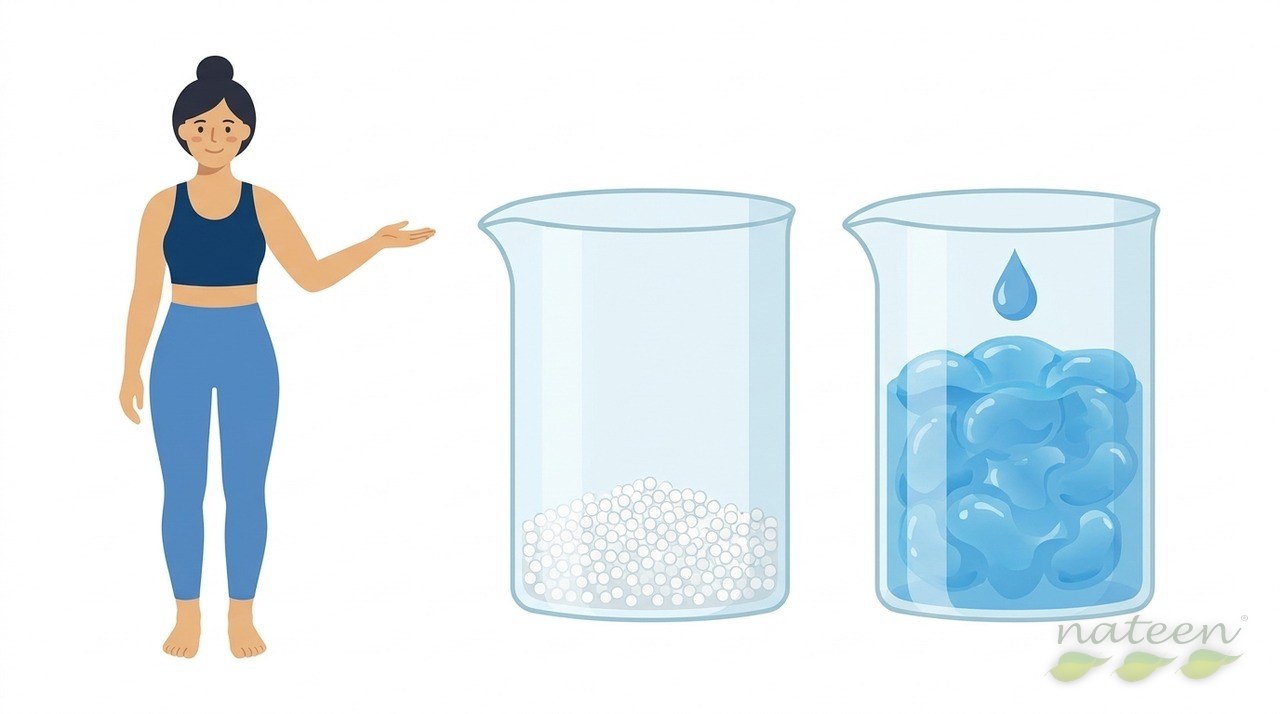
A grain that becomes gel
SAP is a cross-linked sodium polyacrylate in grains of a few hundred microns. On contact with liquid, each grain swells into a gel that does not release water under moderate pressure. This gel is what keeps the skin dry.
The ions present in urine reduce swelling compared with pure water. That is why an absorption value must always state its test liquid, and why we also track capacity in saline solution.
Speed versus retention
A fine grain swells fast; a coarser grain holds more under pressure. A distribution that is too fine creates gel blocking: the surface gel closes the way. We choose the particle size and combine several grades to keep the core permeable to the last void.
Where the SAP sits in the core matters as much as how much there is: concentrated at the front for a man, spread further back for a night product.
What SAP also does, and what it does not
Depending on its grade, superabsorbent also captures, to varying degrees, the ions responsible for the smell of urine, such as ammonium and other nitrogen compounds. That is a bonus, not its first property: its job is to hold liquid. It does not replace good distribution: without cellulose or a distribution layer, it saturates locally. Nor does it handle rewet alone: the whole core keeps the liquid away from the skin.
Superabsorbent is a non-toxic, non-irritating material. It is found in many medical applications, in everyday objects and in agriculture, where it holds water at the roots of plants.
Several grades of superabsorbent from qualified suppliers, chosen for kinetics and particle size, dosed and positioned per range and per user.
- SAP holds, cellulose distributes.
- Speed and retention do not always go together: we combine them.
- Always ask for the test liquid behind an absorption figure.
These pages describe materials and test methods in general terms. The exact characteristics of each product are on its technical sheet; they evolve with our laboratory work.